
Author: Rubens Santana
Hello everyone, how are you all? I hope so. So let's go. In today's post I survey the Proposals/Work Plans which were presented by the Organizações da Sociedade Civil – OSCs, in the year of 2021, near to General Budget of the Union – OGU/2021, by More Brazil Platform – B+W, old SICONV.
First of all, it is important to provide some clarifications:
First, this analysis does not compute the Proposals presented through other Platforms, such as: SIMEC, FNS. SIGTV and etc.
Second, this analysis does not survey the indications that were directed through Funds, type: Fundo Nacional de Saúde, Fundo Nacional da Assistência Social, Fundo Nacional de Educação and etc.
Third, the surveys were carried out with data extracted from the Mais Brasil Platform – B+B, names of November/2021, as we are already in December/21, it is possible, upon further analysis, to verify that the information is already discrepant.
Room, all data was collected from the B+W. In this case, I just collect the information and perform a technical reading of the numbers collected. Therefore, I cannot categorically state that the data extracted from the Platform is 100% accurate. In any case, if you have any doubts about the content of this post, you can contact me via WhatsApp so that we can exchange ideas and check together the information provided in this post.
So, without further ado, lol, let's get to the point.
PROPOSALS PRESENTED ON THE MAIS BRASIL PLATFORM FROM 2008 TO 2021

In 2008 It is 2021 were presented by Third sector (Organizações da Sociedade Civil – OSCs) at More Brazil Platform – B+W, 60,924 Job Proposals after Fund-raising near to Federal Public Power, more specifically, with the General Budget of the Union – OGU.
On average, it is presented to B+W about 4.351 proposals. It appears that there was 2009 It is 2010 a boom of Proposals, going from 10 thousand proposals presented. However, the following year, 2011 From then on, the number of proposals returns to average.
During this period of 2008 until 2021 There were several changes, changes of all sorts. Changes in government and management were implemented and improved B+W, the Marco Regulatório das Organizações da Sociedade Civil – MROSC – Law No. 13,019/14, which provided greater legal tranquility in the relationship between the Federal Public Power and the Organizações da Sociedade Civil – OSCs.
It is interesting to note that, even with the advent of MROSC, there was no change in the modus operandi das CSOs at Fund-raising near to OGU, it can be seen that there was even a decrease, which had already been accentuated in the analysis of previous years.
Given this, it is possible to infer several situations: 1. O Regulation mark Still, let's put it this way, it didn't catch on; 2. To the CSOs they still have little knowledge of how the legislation works, the Development Terms, Notices, Public Calls, etc.; 3. It is unclear to CSOs how does it work MROSC; 4. It is not clear, on the part of the Federal Public Power, a more efficient public policy specifically aimed at qualifying and improving CSOs in its training to be qualified to receive indications from federal public financiers, through parliamentary amendments, notices, public calls, resources from ministerial programs, etc.; 5. The difficulty on the part of CSOs to prepare and adapt to receive nominations from the Federal Government is still large, with few professionals qualified to present a Pwork proposal at B+W with minimum technical quality.
Contracting Type
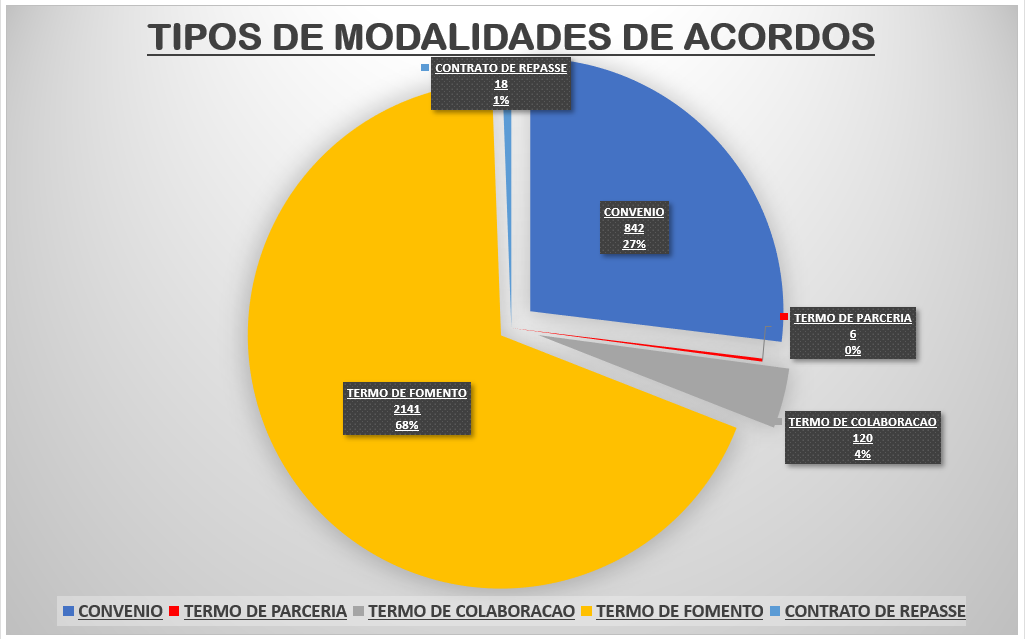
Basically, it is possible for CSOs to be able to present Proposals next to B+W in five models of Agreements, Agreements, Termos de Parceria, Terms of Collaboration, Development Term It is Transfer Agreement.
ADMINISTRATIVE AGREEMENT
Convênio administrativo in Brazilian public administration, refers to agreements signed between a federal public administration entity and a state, district or municipal public entity of direct or indirect administration or private non-profit entities, CSOs, to achieve objectives of common interest among participants (called participants).
It is good to clarify that there is a common sense within the scope of the federal public power to treat any type of agreement by naming it as Health insurance. The practice, however, is not technically correct, since each Type of Agreement possui características técnicas e legais distintas, o que as diferenciam substancialmente, igualmente, existe o próprio termo, Convênio, e esse apresenta um regramento jurídico bem definido.
O ADMINISTRATIVE AGREEMENT at public administration Brazilian, refers to agreements signed between a public administration entity federal and a state, district or municipal public entity of the direct administration or indirect or private non-profit entities, to achieve objectives of common interest among participants (called participants).[1] They are not equipped with legal personality, as they depend on the will of each person and are not binding, that is, they do not lead to legal obligations.[1] At the federal level, the topic is partially regulated by the Decree No. 6,170/2007, which deals exclusively with onerous agreements. Matter is also regulated by Ordinance No. 127/2008 que dá outros pormenores sob a ótica do Tesouro Nacional.[1] A formação de um convênio é uma das formas possíveis de disciplinar a transferência de recursos financeiros de dotações consignadas nos Federal Tax and Social Security Budgets.[1]
It is not a contract, and yes from a agreement, as it is not binding nor does it have parties with conflicting interests.[1][2]
The matter is treated in a scientific work[3] who identified 9 types of agreements ranging from agreements between States, Tax on Circulation of Goods and Services, formation of public consortia, obtaining joint data, delegation of responsibilities, cooperation in matters of common competence of the administrative units, agreements with NGOs (iincluding relationship with organizações sociais It is organizações da sociedade civil de interesse público, organizações da sociedade civil com nomenclatura “contrato de gestão”, “termo de parceria”, “termo de colaboração”, “termo de fomento”), in addition to internal agreements with the Public Administration.
Of the 842 Agreements presented in the exercise of 2021 the vast majority are among Ministries and the UFederal universities, Federal Institutes It is Foundations connected directly to the Federal Public Power. At the Ministry of Health, to the CSOs who receive indication of resources for Investment, for construction It is acquisition of permanent equipment, end up receiving the indication through the Fundo Nacional de Saúde – FNS, and these indications are sent through the Municipal Health Funds – FMSs and the FMSs that transfer resources to CSOs.
Thus, in this case, there is between the Ministry of Health through Fundo Nacional de Saúde – FNS and the Fundo Municipais de Saúde – FMSs, Common Interest Agreements and not contracts, which is why this relationship is called Health insurance and not Termo de Fomento, Colaboração ou Parceria.
In that case, the Propostas de Investimentos of the Health area after the initial process in the FNS platform is forwarded to the Mais Brasil Platform – B+B being transformed into Health insurance e onde são realizados todos os trâmites legais do processo de execução e prestação de contas.
TERMO DE PARCERIA
O TERMO DE PARCERIA and the legal instrument which celebrates the bond between the Public Power and the Organizações da Sociedade Civil de Interesse Público (OSCIP). Devendo estar previstos nele os direitos e as obrigações dos pactuantes, tais como objeto do ajuste, metas, prazos, critérios de avaliação, previsão de receitas e despesas, formas de prestação de contas, etc. Está previsto na Federal Law No. 9,790, of February 23, 1999.
It is interesting to note that, from the MROSC to the OSCIPs, were and are being treated as Organizações da Sociedade Civil – OSCs, as well as other species of Third Sector Organizations, such as Non-Governmental Organizations – NGOs, Associations, Foundations, Unions, Cooperatives, Organizações Sociais – OSs, Religious Associations, among others, well, almost all types of Third Sector Organizations are framed as Organizações da Sociedade Civil – OSCs and must comply with the rules established in Law No. 13,019/14 – MROSC, when it comes to agreements with the Federal Public Power.
Of the Proposals presented with the B+W O Partnership Term is that it presented the smallest number of proposals. Only 6 terms were found on the platform in the exercise of 2021. This could be due to several factors, the first of which is that there are actually fewer organizations certified as OSCIP. Second, because part of the OSCIPs remuneram a diretoria, e geralmente os recursos públicos federais não permitem a remuneração da diretoria em nenhuma hipótese. Assim, acaba que essas instituições não podem pleitear, buscar ou serem indicadas nos recursos públicos federais. Sobrando somente aquela que expressam taxativamente em seus contratos sociais a não remuneração da diretoria. Terceiro, acaba que o próprio poder público convenia com as OSCIPs through Terms of Collaboration or Promotion instead of using the Partnership Term.
COLLABORATION TERM
O COLLABORATION TERM concerns the instrument through which partnerships established by the public administration with the CSOs to achieve purposes of public and reciprocal interest, proposed by the public administration that involve the transfer of financial resources.
Of the total of 3.217 proposals presented in 2021, 120, only 4%, were from Terms of Collaboration. Generally the TC occur through Public Call, já que nesse caso, a iniciativa do processo origina-se no Órgão Concedente.
Proposals are sometimes presented in the B+W mesmo sem haver um Chamamento Público em aberto ou um Edital aguardando inscrições. A Instituição só cadastra uma proposta, porque tem um Programa aberto. Para esse modelo de cadastramento dá-se o nome de Propostas Volunteers.
In this regard, regarding registration of Voluntary Proposals, without there being a clear perspective of the possibility of analyzing the proposal, I am generally very skeptical, and I prefer not to register or guide registration in this model of Fund-raising, the chances of it working are almost nil. In other words, you have to do all the work of preparing a Proposal, sometimes adding documentation, proof, certificates, price sheets, etc., without even knowing whether your proposal will be analyzed, I believe it is a counterproductive task.
TERMO DE FOMENTO
O TERMO DE FOMENTO represents the instrument through which partnerships established by the public administration with the CSOs for the achievement of purposes of public and reciprocal interest propostas pelas Organizações da Sociedade Civil, that involve the transfer of financial resources.
In 2021 were presented at the B+W 2,141 Promotion Terms, 68% of the Proposals were in this modality. O TF is the most used system for several reasons, perhaps the most important of which is that most indications of Federal Public Financiers, deputy and senators, use this legal arrangement.
A Law No. 13,019/14, Marco Regulatório das Organizações da Sociedade Civil – MROSC, trouxe maior garantia jurídica aos partícipes do Orçamento Público, o que acabou tranquilizando esses Financiadores.
Prior to the law, many financiers found it very difficult to indicate resources in this modality, as the legislation that dealt with the topic was dispersed and poorly organized, giving rise to legal and legal doubts and fears, which made it very difficult for CSOs participate more effectively in the General Budget of the Union – OGU.
Gradually after 2016, we found that federal financiers began to show greater legal tranquility to indicate public resources from the OGU to the CSOs, without worrying so much about whether there will be any technical or legal problems.
Today, there are still many financiers who are wary of this resource indication model, in order to CSOs, but much less. There are still some technical issues to be overcome: such as the qualification of CSOs and its professionals; few institutions with the technical capacity and qualified professionals to reasonably include the Proposals in the B+W, carry out due diligence and keep all stages of the process error-free.
I understand that it is necessary for the federal government to develop a public policy to qualify institutions in general. O MROSC It really was a watershed, but it ended up narrowing the funnel too much, few institutions have a technical team with such competence.
I understand that part of this is the responsibility of the Federal Government and it should act more effectively on this front, qualifying CSOs to access, register, execute and report through the B+W.
Attention, basically the difference between the Termo de Colaboração – TC and the Development Term – TF está relacionado à iniciativa, no TC a iniciativa é da Administração, em contra partida no TF a iniciativa é das CSOs.
CONTRATO DE REPASSE
And finally, the CONTRATO DE REPASSE, diz respeito ao instrumento jurídico de contratualização por meio do qual a transferência dos recursos financeiros processa-se por intermédio de instituição ou agente financeiro público federal, atuando como mandatária da União, tais como Caixa Econômica Federal – CAIXA, Banco do Brasil – BB.
1 % das Instituições utilizaram o Contrato de Repasse. Todas da área de saúde e para atender a área de investimentos, mais especificamente obras e serviços de engenharia. Geralmente só Great Players of Third sector in the health sector have technical conditions, professionals and service structures with the capacity to execute resources originating from Transfer Agreement. Geralmente a mandatária desses contratos é a Box, and the requirements for implementing this type of resources are herculean. If the institution does not have a highly qualified technical team, it will not be able to reach good terms in this type of contract.
Below is the list of institutions that presented proposals in this modality:
ASSOCIACAO BENEFICENT HOSPITALAR SAO RAFAEL ARCANJO, IRM SENHOR DOS PASSOS AND STA CAS MISER GUARATINGUETA, IRM SENHOR DOS PASSOS AND STA CAS MISER GUARATINGUETA, BROTHERHOOD OF THE SANTA CASA DE MISERICORDIA DE SOROCABA, SANTA CASA DA AMAZONIA, HOSPITAL INFANTIL PALMIRA SALES, ASS OCIACAO GUIOMAR JESUS DE PREVENTION AND HEALTH CARE, IRMANDADE DE MISERICOORDIA DO JAHU, FUNDACAO FACULTADE DE MEDICINA, RMANDADE DA SANTA CASA DE MISERICORDIA DE SOROCABA, FUNDACAO MEDICO ASSIST DO TRAB RURAL DE ITARANA, ASSOCIACAO HOSPITAL BENEFICENTE DE MARACAI, SOCIEDADE BENEFICENTE SAO CAMILO, IRMANDADE DA STA HOUSE DE S VICENTE DE PAULO DE TERRA, FUNDACAO MED E ASSIST DO TRAB RUR DO MUN DE QUITANDINHA, OSPITAL SAO FRANCISCO DE PAULA, SANTA CASA DE MISERICORDIA DE APARECIDA, ANTA CASA DE MISERICORDIA DE TAQUARITUBA.
STATUS OF PROPOSALS
INEFFICIENCY
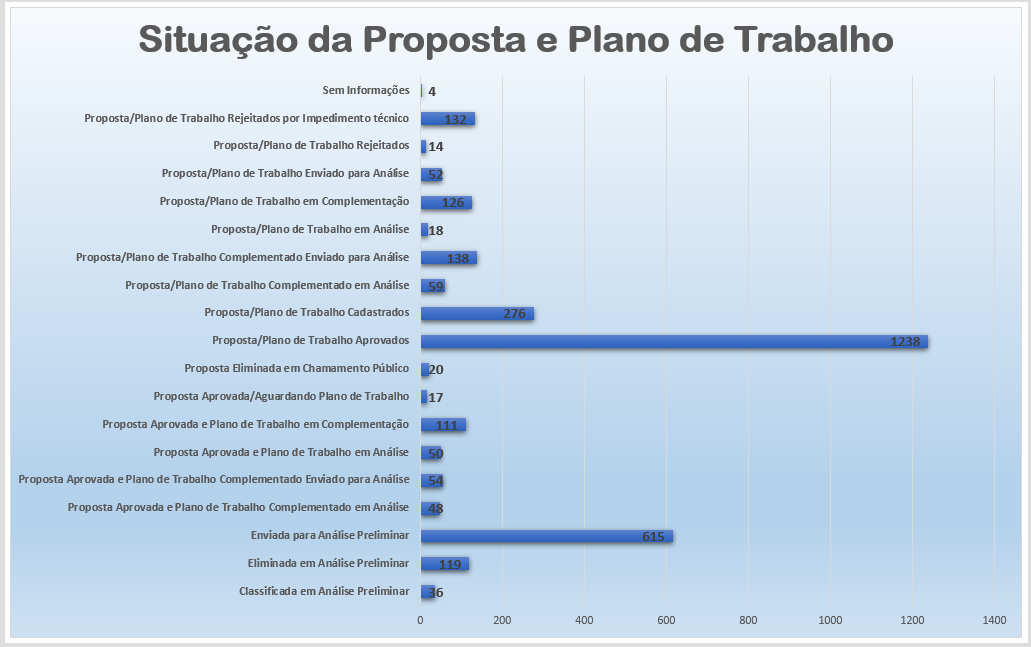
The mining of this content described in the graph above occurred in the middle of the month of October/21, that is, with less than 45 days to end the year. And, from the content of the image, it can be seen that there are many Propostas/Plano de Trabalho that have not yet been approved. If they are not approved, it is not possible to request release of budget limit And much less financial limit. By law, these Proposals must be approved and committed by the day December 31st of each year. If they are not committed by that date, the resource is lost.
Das 3.127 Proposals presented 1.238 of Proposals and Work Plan are approved, committed or ready for commitment. With just a few days left until the end of the year, just 39,59% of the Proposals presented a process of EFFICIENCY. Which is completing the basic analysis steps in the minimum time necessary. In other words, if the year ended today, around more than 60% of all proposals submitted to the B+W through General Budget of the Union para o Terceiro Setor estariam LOST.
Thus, the situation is as follows, in, about 45 days, you Granting Bodies and the Covenant Institutions will have to resolve all pending issues identified in the proposals presented, something that should have already been resolved in the 1st1 months, and which have not been resolved. The chance of losing resources is enormous, the inefficiency in this system is staggering and everyone is penalized in this process, especially the population at the point, who are unable to receive the solutions and public policies of our budget system. We need to change this.
Well, it's good to clarify some points here, specifically in my analysis above. Das 60,41 % of the Proposals presented, 146 they're gone reject It is 20 they were eliminated in Public Calls. In other words, for these, the process is also completely closed, with no chance of analysis, reanalysis or continuation. Which ends up reducing a little, in my opinion, the PERCENTAGE OF INEFFICIENCY, but it still remains a resounding value.
TIPOS DE INVESTIMENTOS

In the proposals presented in 2021, 3 tipos de investimentos se destacam: 1.115 proposals are for acquisition of equipment, 865 are for acquisition of equipment combined with the costing execution, It is 1.050 proposals are exclusively for costing execution.
Costing expenses, are resources for maintaining existing services in the institution, through the execution of programs, projects, maintenance of administrative activities, acquisition of consumer goods, third-party services, maintenance of equipment, expenses with water, energy, telephone, etc. (contents governed by the system of each Action).
Equipment Acquisition, this item includes the acquisition of all types of equipment, vehicles, durable movable assets, permanent or not.
Here are some clarifications for Third Sector Organizations. The Federative Organization of Brazil is divided into 3 levels, Union, States/Federal District and Municipalities. A Law No. 13,019/14 veio democratizar, regulamentar e proporcionar maior transparência na relação entre Unity It is Third sector (Organizações da Sociedade Civil – OSCs), e estabeleceu três níveis de relacionamento quando se trata de experiência na prestação de serviços pelo terceiro setor. Que ele apresente 1, 2, or 3 years of existence.
Aquelas instituições mais recentes, que existem a pouco tempo, a cerca de um ano, precisa entender que a relação, em termos de parceria pública não deve começar com a Unity. A Unity wants to indicate resources for Organizations already established, already organized, which already have a minimum structure to serve the population, because federal public resources are generally larger and more voluminous. So much so that in budget legislation the minimum value to be indicated is 100 thousand reais. Most institutions in Brazil that you recommend 100 thousand reais to them will not even know what to do effectively with that money. It is very likely that a President will take money intended for school lunches and buy a fishing boat for his association.
Thus, if your institution has been in existence and experience for around one year, seek partnerships with the municipal government, if it has been in existence for around two years, seek partnerships with the state, and, if it has been in existence for more than three years and has experience, then yes, your institution is ready to negotiate with the federal public authorities.
What I see a lot are institutions trying to skip steps. People create the institution today, and next month they want to reach the General Budget of the Union and qualify to receive resource referrals. The legislation does not allow this. DO NOT BURN STEPS.
In the graph above, the types of investment for: 1, proposal is for Equipment/Works and Engineering Services, 29, for Execution of Costing/Works and Engineering Services and 23, for Engineering Works and Services, most of these Proposals are for Hospitals, mainly large ones, Universities, Santas Casas. This occurs because legislation prohibits investment in works/construction for the Third sector in general.
Like this, Institutions of Third sector do not try to raise funds from the General Budget of the Union – OGU for acquiring land for the Institution, building headquarters, expanding the Organization’s structure, etc. A LEGISLATION DOES NOT ALLOW the increase in valor venal of the Institution. But as stated above, there are exceptions.
PROPOSALS SUBMITTED BY STATE

In the table above we have the following columns:
Column A: Position – By Population: The position of the 27 states of the Union by amount of Population;
Column B: Population: Number of inhabitants in each state;
Column C: Name of the State;
Column D: Percentage of Population in the general sum of inhabitants of the Country;
Column E: Number of Proposals: presented at P+B by state;
Column F: Percentage of Projects: presented by state in P+B;
Column G: Position of the Proposals Presented – Position of the State by number of Proposals presented.
Surveying the information presented in the spreadsheet above, relating the number of inhabitants of each state to the number of proposals presented to the B+W, I made the following divisions and inferences:
I established the 3 States MORE EFFICIENT, you 3 States MEDIAN and the 3 States LESS EFFICIENT regarding the number of proposals presented on the platform.
In GREEN are the MORE EFFICIENT, in YELLOW you MEDIAN is at RED the MEFFICIENT ENOS.
The most efficient states do not present much news, as they are in southwestern Brazil, São Paulo, Minas Gerais It is Rio de Janeiro, where we find a better distribution of income, greater qualifications and greater capacity of institutions to present a greater number of projects. If we make the comparison, São Paulo which is the first state in population, ranked first in the presentation of number of projects. Minas Gerais the second in Population I come second in the presentation of number of projects. O Rio de Janeiro, the third state in terms of population, was the fourth to present the largest number of projects.
Paraná, Santa Catarina It is Federal District apresentam uma quantidade de projeto, vamos dizer assim, proporcional ao tamanho das suas populações, mantendo cada um, posições no Rank proportional to the size of its population.
The least efficient states, Ceará, Pernambuco It is For, all in the north and northeast of Brazil, where it is known, have a lower HDI, where technical quality, due to several factors, in addition to geographic position, penalizes CSOs, being less efficient, and end up suffering from the unavailability of technicians and professionals to work in this area of proposal presentation, preparation and approval of projects.
CONCLUSION
Analyzing the content extracted from the B+W verifiquei, entre outras coisas. Realmente ainda precisamos melhorar muito a eficiência do sistema, tanto da parte do poder público quanto das organizações sociais. O processo é moroso, cheio de exigência que poderiam ser reduzidas, melhorando a eficiência.
Improve dialogue between Granting Bodies and the CSOs. He has Ministry that talking to the technician who analyzes the proposals is almost impossible. I think this is absurd. The relationship between the designer of the CSOs and the Ministry's technician should be, in my opinion, as close as possible.
There is a Ministry that the institution does not have access to the technician who analyzes the proposal. If the designer of the CSOs wants to know technical information, even the slightest bit, he has to activate the ASPAR, The Parliamentary Advisory of Ministry for this, call the technician, the technician will analyze, respond to the ASPAR and the ASPAR respond to the designer. This is absurd, it is an insult, it is a lack of respect. It's not correct.
I've already complained, I've complained, but the Ministry simply shrugged it off. He understands that political control is more important than technical efficiency, ugh, you'll understand. So it is difficult for Brazil to move forward.
I also think, and this is a personal struggle of mine and some technical colleagues from the Federal Public Budget. The Federal Public Power created legislation that was missing, the Law No. 13,019/14, que chegou em excelente momento, a pesar de eu entender que ela estava atrasada, no mínimo, uns 20 anos. Mas de toda forma aconteceu, e está aí. Excelente legislação, democrática, clara, eficiente e faz o que propõe orientar e disponibilizar maior transparência nas transferências de recursos públicos para as Civil Society Organizations.
However, what is the biggest mistake Executive power and of Federal Public Legislators. Proposing solutions without adequate execution planning. Both the Executive and mainly the legislative They are masters in this type of solutions. Creating regulations without providing the necessary adjustments for implementation, especially the requirements of these regulations. Often, in the end, this creates more chaos than the legislative solution itself.
Today, with the MROSC what is the biggest bottleneck in Capproval of Federal Public Resources by the CSOs, the lack of technical qualifications of CSOs institutions. It's like that first job question. I have a vacancy but I require experience. I don't believe it is necessarily the role of Unity propiciar ao terceiro setor ferramentas de qualificação. Mas venhamos e convenhamos. Do que adianta criar uma lei se você não propiciar os mecanismos da eficiência dessa lei. Penso ser totalmente contraproducente.
Given this, I think that the Executive power has an enormous responsibility in developing public policies to qualify the Third sector in their access to resources and opportunities arising from Law No. 13,019/14, even because, at the end, those who meet a large part of the population's demand are the Third sector. Just look at how many private, non-profit hospitals there are and the number of people who pass through these institutions every day, and you will see that the numbers are frightening. It's too much.
I hope you like this analysis. Please provide your reviews below. I am a fan of critical questioning, I feel very comfortable answering them.
A hug and success to everyone.
If you liked this post, please make your comment below or like our social networks, this helps us to continue producing quality and relevant content.
If you need any information, call me on Whatsapp