
The post made available by the Observatory of Third sector and Written by Edmond Sakai, sheds light on research carried out by Institute for the development of Social Investment – IDIS, on the habits of Donation of individuals in Brazil.
A Search Donation Brazil 2020, coordinated by IDIS – Institute for the Development of Social Investment, and carried out by Ipsos, also included the participation of professionals and activists from the Culture of Donation in Brazil. Most comprehensive study on the habits of Donation of individuals in Brazil, was carried out for the first time in 2015 and the expectation is that it will be repeated every five years, to monitor the evolution of the culture of Donation in the country.
The research, which combines quantitative and qualitative methodologies to create a true x-ray of the Culture of Donation in Brazil, brings many interesting and valuable results for everyone who works in the area of Philanthropy, Third sector It is Social Impact. It's worth taking your time to analyze the full report, but I'll mention here what caught my attention the most.
Crisis had a strong impact on donations
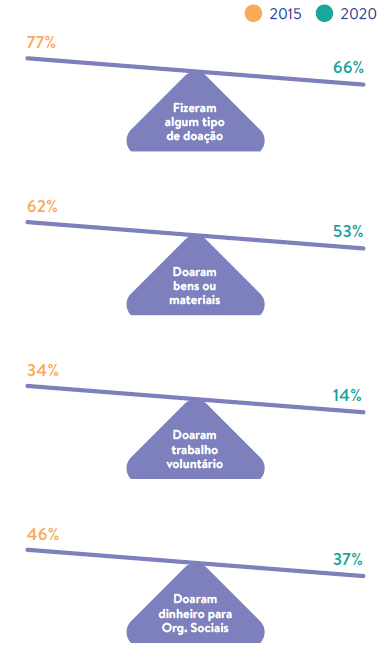
The socioeconomic crisis accentuated by the pandemic resulted in a drop in donations of all types: money, goods and voluntary work. While, in 2015, 77% of the population had made some type of Donation, in 2020, the percentage was 66%. When it's about Donation in cash, the ratio fell from 52% to 41%. The percentage of donors to socio-environmental organizations and initiatives shrank from 46% of the population, in 2015, to 37% in 2020.
The reduction occurred mainly among the less favored classes, who saw themselves transformed from donors in 2015 to dependent on donations in 2020. Donation of money fell from 32% to 25% between 2015 and 2020, in the range with family income up to 2 minimum wages. Despite this, half of people from classes C2/D/E, even in the face of vulnerability and uncertainty, donated goods and materials.
The most favored classes significantly increased their volume of donations, from 51% to 58%, in classes with family income between 6 and 8 minimum wages, and from 55% to 59% among classes with family income above 8 minimum wages. This shows that despite the difficulties, and perhaps precisely because of them, Brazilians increased their sense of Solidarity and empathy.

The population trusts the work of CSOs
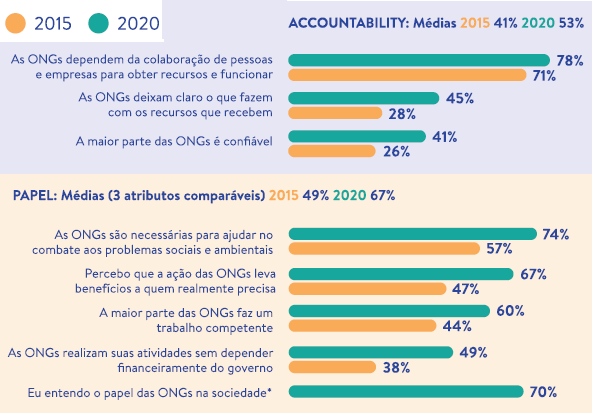
Other survey data confirm this perception, which reflects the appreciation and confidence in the work carried out by CSOs.
The relevance of these organizations is recognized by 74% of the population, who see them as necessary to help solve social and environmental problems, and 60% of Brazilians agree that CSOs carry out competent work, numbers higher than those found in the previous edition.
From 2015 to 2020, the proportion of people who think that the government is primarily responsible for tackling social problems also fell, while the perception of the responsibility of companies, CSOs and the population in general grew.
Motivations for donating and perceptions about the gesture
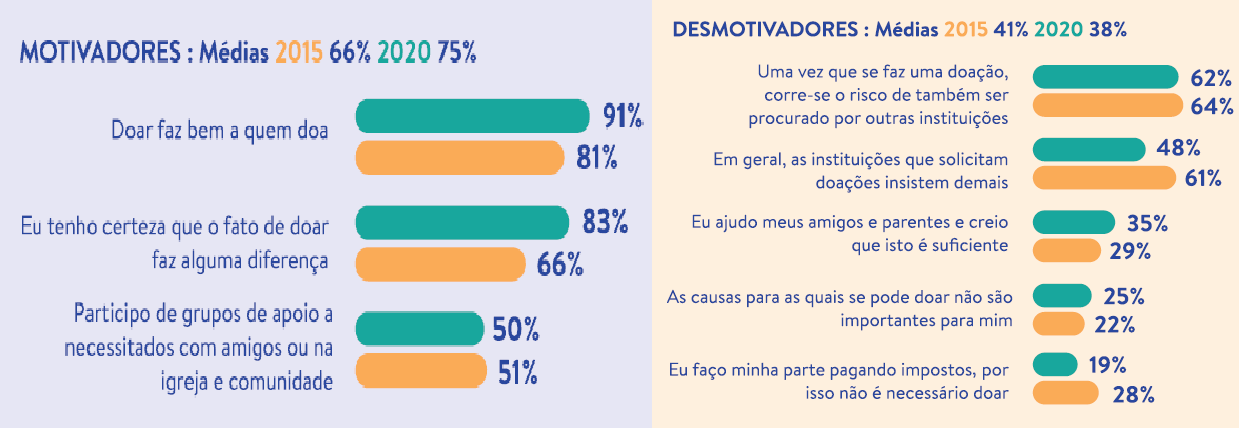
As for the motivation to donate, Brazilians believe that donating is good for the person who donates (91%) and they are sure that donating makes a difference (83%).
The most important aspect associated with the practice of giving has remained stable: that it must be done without expecting anything in return, out of authentic generosity, selflessly. 91% thought this in 2015 and 94% in 2020, that is, almost unanimously.

Motivation to Donate
The perception that those who donate should not say that they make donations is still strong, but it fell from 84% in 2015 to 69% in 2020. This data is important because talking about the Donation it stimulates your practice, brings inspiration, clarifies fears and awakens the interest of other people.
The authors of the research analyze that this culture is slowly changing, from a “Christian” perception that “the right hand should not know what the left hand does” to a record based on citizenship, in which publicizing the act of donating promotes the collective good by encouraging others to repeat the gesture. Through campaigns that explore this key, it is possible to accelerate this change.
More and more Brazilians are clear about the benefits of Donation and makes the decision to donate based on objective factors, linked to causes they value and entities they trust. According to the research, “it is a considered, planned decision and demonstrates a worldview that values citizenship, reciprocity and empathy, in addition to personal development”.

There are many other interesting insights in the research, but so as not to dwell here, I reiterate that the full report is worth reading. Mainly the qualitative dimension of the research brings many inputs to base marketing campaigns. Donation. The more information, the better!
Follow this link the file with the Complete Search.
Text extracted with adaptations from Observatory website Third sector.